
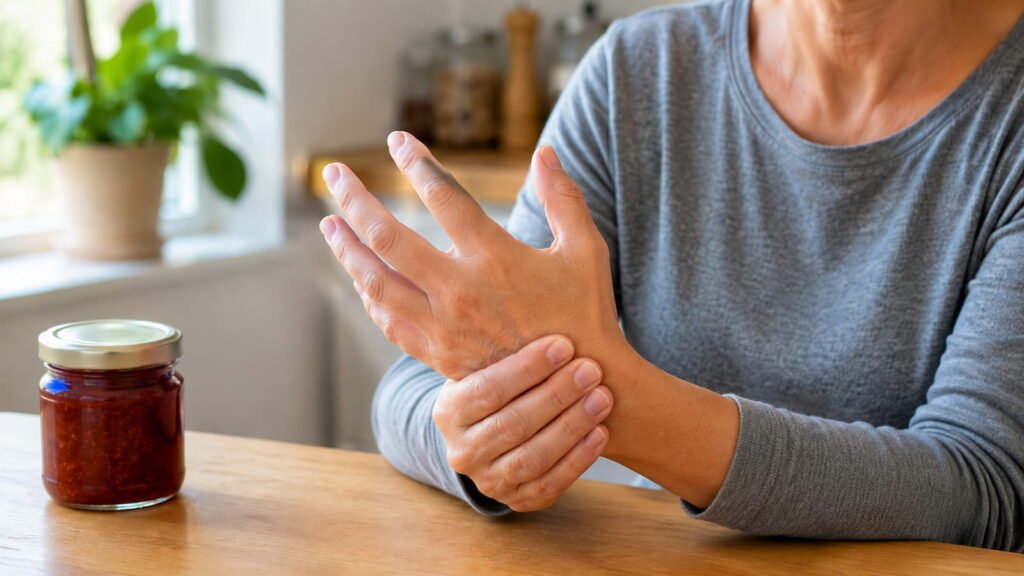
Thumb joint pain can make simple daily activities surprisingly difficult. Opening a jar, turning a key, buttoning clothes, holding a cup, or pinching a small object may suddenly become uncomfortable.
Pain during gripping or pinching can come from the joint at the base of the thumb, but it can also come from nearby tendons, ligaments, or other structures in the hand and wrist. Thumb-base osteoarthritis is one possible cause, especially when pain is centered where the thumb meets the wrist, but it is not the only explanation.
The location of the pain, how it started, and whether you also have swelling, stiffness, clicking, numbness, or weakness can provide useful clues. These clues cannot diagnose the problem on their own, but they can help you understand when simple self-care may be reasonable and when professional evaluation is more appropriate.
Why Does My Thumb Hurt When I Grip or Pinch?
The thumb plays a major role in gripping and pinching. Its joints and surrounding tendons allow the thumb to move across the palm and work against the fingers. This motion gives the hand much of its ability to hold, twist, squeeze, and manipulate objects.
When you open a jar, turn a doorknob, use scissors, hold a heavy mug, or pinch something between your thumb and index finger, substantial force passes through the thumb.
If a joint is irritated, a tendon is inflamed, or a ligament has been injured, those movements may make the problem more noticeable.
The exact pattern matters. Pain directly at the base of the thumb may point toward a different problem than pain along the thumb side of the wrist or pain accompanied by clicking and locking.
That is why it is better to think of thumb pain as a symptom with several possible causes rather than assuming that every painful thumb has arthritis.
Common Causes of Thumb Joint Pain When Gripping
1. Thumb Base Osteoarthritis
Osteoarthritis can affect the carpometacarpal, or CMC, joint at the base of the thumb. This is the joint where the thumb connects to the wrist area.
The condition involves changes in several tissues within the joint over time. As osteoarthritis progresses, the joint may become painful, stiff, swollen, or less stable.
A common symptom of thumb-base osteoarthritis is pain during activities that require gripping or pinching. Opening jars, turning keys, twisting lids, using tools, or holding objects tightly may become uncomfortable.
Other possible symptoms include:
- Tenderness near the base of the thumb.
- Reduced grip or pinch strength.
- Stiffness.
- Swelling.
- Reduced thumb movement.
- A gradually enlarging or bony-looking joint in more advanced cases.
Osteoarthritis becomes more common with age, but age alone does not prove that arthritis is causing your symptoms. Previous joint injuries and other individual factors can also influence risk.
If you are trying to understand how different forms of arthritis compare, our guide to osteoarthritis vs rheumatoid arthritis explains their major differences.
2. De Quervain’s Tenosynovitis
Sometimes pain that feels as though it comes from the thumb joint is actually coming from tendons on the thumb side of the wrist.
De Quervain’s tenosynovitis affects tendons that help move the thumb. Pain is usually felt near the base of the thumb or along the thumb side of the wrist.
Gripping, twisting, lifting, or moving the thumb and wrist repeatedly can aggravate the symptoms. Some people also notice swelling or difficulty moving the thumb comfortably.
This condition is important to distinguish from arthritis because it primarily involves tendons rather than the thumb joint itself.
Repetitive hand use may aggravate de Quervain’s symptoms, but it is better not to assume that one particular activity caused the condition. Its exact cause is not always clear.
3. Trigger Thumb
Trigger thumb is another tendon-related condition that may initially be described simply as thumb pain.
The tendon that bends the thumb normally slides through a supporting structure called a pulley. When movement becomes restricted, the thumb may catch, click, pop, or temporarily lock as it bends or straightens.
Pain or tenderness may occur in the palm near the base of the thumb. Some people notice stiffness or a small tender area in this region.
A catching or locking sensation makes trigger thumb different from typical thumb-base osteoarthritis, although more than one hand condition can occasionally occur in the same person.
4. Thumb Sprain or Other Injury
If thumb pain began suddenly after a fall, awkward bend, impact, sports injury, or forceful movement, an injury should be considered.
Ligaments help stabilize the joints of the thumb. Stretching or tearing one of these ligaments can cause pain, swelling, bruising, weakness, or instability.
Fractures and other injuries can produce similar symptoms, especially after significant trauma.
New pain after an obvious injury should therefore not automatically be treated as arthritis or repetitive strain.
Severe pain, visible deformity, major swelling, inability to move the thumb, or inability to hold objects requires more urgent assessment.
5. Rheumatoid or Other Inflammatory Arthritis
Inflammatory forms of arthritis can also affect joints in the hands.
Rheumatoid arthritis, for example, is an autoimmune disease that can cause pain, swelling, stiffness, and reduced joint function. The pattern is often different from isolated thumb-base osteoarthritis because multiple joints may be affected.
Prolonged morning stiffness, swelling in several joints, or symptoms affecting both hands may increase the reason to seek medical assessment rather than assuming the problem is simply mechanical.
Other inflammatory conditions can occasionally cause sudden or marked joint symptoms as well.
A hot, very swollen joint—especially when accompanied by fever or feeling generally unwell—should not be managed as ordinary thumb soreness without medical advice.
What Can the Location and Pattern of Thumb Pain Tell You?
Where you feel the pain can provide useful clues, although location alone cannot confirm a diagnosis.
Pain at the Base of the Thumb
Pain where the thumb meets the wrist, particularly during pinching or gripping, can occur with thumb-base osteoarthritis.
Stiffness, tenderness, reduced grip strength, or swelling may occur alongside the pain.
Pain Along the Thumb Side of the Wrist
Pain extending toward the wrist may be more suggestive of a tendon problem such as de Quervain’s tenosynovitis, especially when gripping, twisting, lifting, or moving the wrist makes it worse.
Pain With Clicking or Locking
Pain near the palm combined with clicking, catching, or temporary locking of the thumb may fit the pattern of trigger thumb.
Pain After an Injury
Sudden pain, bruising, swelling, instability, or difficulty moving the thumb after trauma raises concern for a sprain, fracture, or another injury.
Pain With Numbness or Tingling
Numbness, pins and needles, or altered sensation may suggest that a nerve problem is contributing to the symptoms rather than the thumb joint alone.
Persistent numbness or loss of sensation deserves medical evaluation.
Thumb pain can also occur without obvious swelling. If that is your main concern, our guide to joint pain without swelling explains several reasons joints may hurt even when they do not look swollen.
What Can Help Mild Thumb Pain at Home?
If the pain is mild, there has been no major injury, and no warning signs are present, several conservative measures may help reduce irritation.
The most appropriate approach depends on what is causing the pain, so persistent or worsening symptoms should still be evaluated.
Reduce or Modify Painful Gripping Activities
Temporarily reducing activities that clearly aggravate the thumb can give irritated tissues a chance to settle.
That does not necessarily mean avoiding all hand movement.
Instead, look for ways to reduce excessive pinching and forceful gripping.
- Use both hands instead of one when lifting heavier objects.
- Avoid gripping tools more tightly than necessary.
- Use jar-opening devices instead of repeatedly forcing tight lids.
- Choose utensils or tools with wider handles when practical.
- Take breaks from repetitive hand activities that increase symptoms.
- Change how you hold an object if another position places less strain on the thumb.
The goal is to reduce unnecessary stress while continuing comfortable movement rather than completely immobilizing a mildly painful thumb for long periods without guidance.
Try Cold or Heat When Appropriate
Cold can be useful when the thumb feels irritated or swollen, particularly following an aggravating activity or a minor recent injury.
Wrap a cold pack in a cloth rather than applying ice directly to the skin.
Heat may feel more comfortable for some people with ongoing stiffness, particularly when there is no recent injury or significant swelling.
Which feels better can vary from person to person and from one condition to another.
Our guide to heat or ice for joint pain explains when each approach may be more appropriate.
Consider a Thumb Support or Splint
A properly fitted thumb support may reduce painful movement and help some people perform daily activities more comfortably.
Splints are used for several thumb and wrist conditions, but the best style and wearing schedule depend on the underlying problem.
Wearing a poorly fitting brace continuously can also be uncomfortable or unnecessarily restrict movement, so a healthcare professional, physical therapist, occupational therapist, certified hand therapist, or pharmacist can help if you are unsure which support is appropriate.
Be Careful With Over-the-Counter Pain Medicines
Over-the-counter pain relievers may be appropriate for some people, but they are not suitable for everyone.
For example, nonsteroidal anti-inflammatory drugs, or NSAIDs, can carry risks and may not be appropriate for people with certain stomach, kidney, cardiovascular, bleeding, pregnancy, allergy, or medication-related considerations.
Follow the product label and ask a healthcare professional or pharmacist if you have medical conditions, take other medicines, are pregnant, or are uncertain about which option is safe for you.
Keep the Thumb Gently Moving
Unless an injury requires immobilization, complete avoidance of movement is not always helpful.
Gentle, comfortable movement may help limit stiffness.
However, exercises should not involve repeatedly forcing the thumb through significant pain.
If movement is increasingly difficult or you are unsure what exercises are appropriate, professional guidance is preferable to experimenting with aggressive stretching or strengthening.
When Should You See a Healthcare Professional?
Mild thumb pain caused by temporary irritation may improve with activity modification and simple self-care.
Professional evaluation becomes more important when symptoms persist, worsen, recur frequently, or begin interfering with normal hand function.
Consider arranging a medical evaluation if:
- Thumb pain is getting worse rather than improving.
- Symptoms continue despite reasonable self-care.
- Pain keeps returning.
- Gripping, pinching, writing, cooking, dressing, or other normal activities become difficult.
- Swelling or stiffness does not settle.
- The thumb repeatedly catches or locks.
- You notice persistent tingling or numbness.
- Grip strength is noticeably declining.
- Several joints are painful or swollen.
- You have prolonged morning stiffness or other symptoms suggesting an inflammatory condition.
Seek more urgent medical care after an injury if:
- Pain is severe.
- You heard or felt a snap, grinding, or significant popping sensation during the injury.
- The thumb looks deformed or has changed color.
- You cannot move the thumb normally.
- You cannot hold objects.
- Part of the hand has lost sensation.
A hot, markedly swollen joint accompanied by fever or feeling very unwell also needs prompt medical attention because causes other than routine mechanical pain need to be considered.
How Is Persistent Thumb Pain Evaluated?
A healthcare professional will usually begin by asking where the pain occurs, when it started, which movements make it worse, whether an injury occurred, and whether you have symptoms such as swelling, stiffness, clicking, weakness, or numbness.
The thumb, wrist, and hand may then be examined for tenderness, movement, strength, stability, swelling, and other physical findings.
Depending on what is suspected, imaging such as an X-ray may sometimes be used. Imaging is particularly useful when arthritis, fracture, or another structural problem needs to be evaluated, but not every case of mild thumb pain requires imaging.
Treatment also depends on the actual cause.
Possible approaches may include:
- Activity modification.
- Splinting or bracing.
- Hand or occupational therapy.
- Appropriate pain-relieving medicines.
- Specific exercises when suitable.
- Injections for selected conditions.
- Treatment of an underlying inflammatory disease.
- Surgery in selected cases when significant symptoms do not respond to conservative treatment or when a serious structural injury requires it.
Because thumb arthritis, tendon problems, injuries, and nerve conditions can create overlapping symptoms, getting the cause right is more useful than treating every case of thumb pain in exactly the same way.
Can Thumb Joint Pain Be Prevented?
Not every cause of thumb joint pain is preventable. Age-related joint changes, inflammatory diseases, previous injuries, anatomy, and other factors cannot always be controlled.
You can, however, reduce unnecessary strain during daily activities.
- Avoid repeatedly forcing painful gripping or pinching movements.
- Use larger handles or assistive tools when they make tasks easier.
- Use both hands for heavier objects when practical.
- Increase new hand-intensive activities gradually.
- Take reasonable breaks during repetitive tasks.
- Address persistent symptoms rather than repeatedly working through substantial pain.
- Use appropriate protective equipment during activities where thumb injuries are possible.
These habits cannot guarantee that arthritis or another thumb condition will never develop, but they may make demanding tasks easier on already sensitive joints and tissues.
Conclusion
Thumb joint pain when gripping or pinching can interfere with many everyday activities, but the symptom does not point to one single condition.
Thumb-base osteoarthritis is an important possibility when pain occurs at the base of the thumb during gripping or pinching. Tendon conditions such as de Quervain’s tenosynovitis and trigger thumb, as well as injuries and inflammatory arthritis, can produce overlapping symptoms.
Pay attention to where the pain occurs, whether it developed gradually or after an injury, and whether symptoms such as swelling, stiffness, catching, weakness, or numbness are present.
Mild symptoms may improve with sensible activity modification and conservative self-care. Persistent, worsening, severe, or function-limiting symptoms deserve professional assessment so the underlying cause can be identified and treated appropriately.
Frequently Asked Questions
Is thumb pain when gripping always arthritis?
No. Thumb-base osteoarthritis can cause pain when gripping or pinching, but tendon problems such as de Quervain’s tenosynovitis or trigger thumb can cause similar symptoms. Sprains, fractures, inflammatory conditions, and nerve problems are other possibilities. The overall symptom pattern matters.
Why does my thumb hurt when I open jars?
Opening a tight jar requires both strong gripping and rotational force. These movements load the thumb and can aggravate an already sensitive CMC joint or nearby tendons. Repeated pain during this activity does not by itself identify the exact cause.
Should I wear a brace for thumb joint pain?
A thumb splint or brace can help some conditions by supporting the area and limiting painful movement. However, the most appropriate type and wearing schedule depend on what is causing the pain. Persistent symptoms are a good reason to ask a healthcare professional, hand therapist, or pharmacist for guidance.
Can using a phone cause thumb arthritis?
It would be inaccurate to say that ordinary phone use has been proven to cause thumb arthritis. Repeated thumb or wrist movements can aggravate existing symptoms and may irritate certain tendons, but aggravating pain is not the same as proving that an activity caused arthritis.

Pingback: Assistive Devices for Arthritis: 12 Helpful Tools