
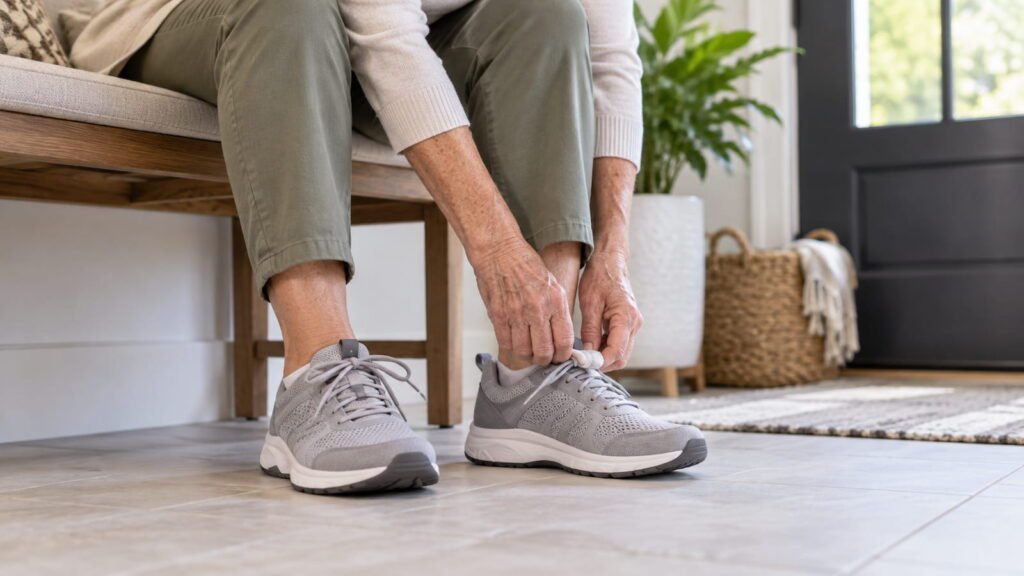
Choosing walking shoes for arthritis can be confusing. Some shoes are marketed as highly cushioned, others emphasize stability, and others promise flexibility or motion control. But there is no single shoe design that is automatically best for every person with arthritis.
The right choice depends on factors such as which joints are affected, the shape of your feet, swelling, balance, walking pattern, and whether you use orthotics.
Research also shows why simple rules can be misleading. In some people with knee osteoarthritis, stable supportive shoes have performed better than flat flexible shoes for walking pain. Other studies have found little meaningful difference between the two categories, especially when footwear was combined with exercise.
This guide explains seven practical features to consider before buying walking shoes, how different types of arthritis may affect footwear needs, and when professional fitting may be worthwhile.
Why Footwear Matters When You Have Arthritis
Walking places repeated loads through the feet, ankles, knees, hips, and lower body. Shoes influence how the foot contacts the ground, how stable the foot feels, and how pressure is distributed while you move.
For someone with arthritis, footwear may matter even more because pain, stiffness, swelling, reduced joint movement, or changes in foot shape can make an otherwise acceptable shoe uncomfortable.
The Arthritis Foundation emphasizes that people with arthritis should consider footwear that matches their particular foot type and joint problems, rather than choosing shoes based only on style or marketing claims.
However, shoes should not be viewed as a treatment that reverses arthritis or repairs damaged cartilage.
A good shoe may support comfort and mobility, but it does not cure the underlying condition.
If walking itself is causing discomfort, our guide to knee pain when walking explains several other reasons that knee symptoms can occur.
7 Features to Look For in Walking Shoes for Arthritis
The following features provide a useful starting point when comparing walking shoes for arthritis, but individual needs vary.
1. Enough Room in the Toe Box
The front of the shoe should give your toes enough room to sit naturally without being squeezed together.
This can be especially important if arthritis affects the toes or forefoot, or if you have swelling, bunions, hammertoes, or other changes in foot shape.
A narrow or shallow toe box can place additional pressure on sensitive areas. Arthritis Society Canada recommends shoes that allow the toes room to move and do not force the foot into an unnatural shape.
The Arthritis Foundation likewise advises paying attention to toe-box width, particularly when swollen or deformed joints are present.
A shoe should fit the foot you have now—not the foot size or shape you remember having years ago.
2. A Secure but Adjustable Fit
A walking shoe should hold the heel securely without excessive slipping, while still allowing enough room for the rest of the foot.
Adjustable fastenings can be particularly useful when swelling changes during the day.
Laces allow precise adjustment, while hook-and-loop straps or elastic laces may be easier for people who have difficulty using their hands.
Versus Arthritis notes that adjustable fastenings can accommodate changes in foot shape while maintaining support. It also suggests alternatives such as elastic laces or hook-and-loop fasteners for people who find traditional laces difficult to manage.
This consideration is easy to overlook when arthritis affects both the feet and hands.
For other tools that may make dressing, gripping, reaching, and everyday activities easier, see our guide to assistive devices for arthritis.
3. Appropriate Cushioning
Cushioning can help reduce the sensation of impact when walking on hard surfaces, but more cushioning is not automatically better.
A very soft shoe may feel comfortable while standing yet provide insufficient stability for someone who needs more control.
The goal is usually a balance between comfort, shock absorption, and stability.
Arthritis Society Canada advises considering cushioning and shock-absorbing soles, especially when spending time on hard surfaces.
However, comfort remains individual. A shoe that feels appropriately cushioned to one person may feel too soft or too firm to another.
Try not to select footwear based solely on marketing terms such as “maximum cushion” or “orthopedic comfort.”
4. A Stable Heel and Sole
The back of a walking shoe should usually hold the heel securely enough that the foot does not slide excessively inside the shoe.
A reasonably stable base can also help the shoe feel more controlled during walking.
This does not mean that every person with arthritis should buy the stiffest or most structured shoe available.
Instead, look for a shoe that feels secure during normal walking without pinching, rubbing, or forcing the foot into an uncomfortable position.
If instability or difficulty walking remains significant even with appropriate footwear, some people may benefit from additional mobility support. Our guide to using a cane for arthritis explains when a cane may be useful and how it should be fitted.
5. The Right Amount of Sole Flexibility or Stiffness
This is where simple footwear advice becomes more complicated.
A flexible sole allows more foot movement. A stiffer sole limits motion through some joints.
Neither is universally better.
For example, when arthritis affects the big-toe joint, reducing painful bending at that joint may sometimes be helpful. NHS guidance for first-toe osteoarthritis notes that stiff-soled footwear can reduce aggravating flexion of the painful joint.
But that does not mean everyone with arthritis should wear rigid shoes.
The appropriate amount of flexibility depends on the joint involved and the person’s individual mechanics.
That is also why biomechanical findings from one type of arthritis should not automatically be applied to another.
6. Good Grip and a Practical Heel Height
A walking shoe should provide enough traction for the surfaces where you normally walk.
A worn or slippery sole may make walking feel less secure, particularly for someone who already has pain, weakness, balance concerns, or reduced mobility.
Heel height also matters.
Higher heels change how forces are distributed through the foot and lower limb. Arthritis Society Canada recommends lower, broader heels rather than routinely choosing high heels.
For everyday walking, a stable and practical heel is generally more useful than a narrow elevated heel.
The sole should also be inspected periodically. Even a shoe that originally fitted well may become less supportive as the tread, cushioning, or heel wears down.
7. Enough Space for Orthotics or Insoles
Some people with arthritis use an insole or prescribed orthotic to change pressure distribution, accommodate foot shape, or improve comfort.
If you use one, take it with you when trying on shoes.
The shoe must have enough internal depth to accommodate the device without compressing the toes or making the shoe excessively tight.
Versus Arthritis specifically recommends trying new footwear while wearing any orthotics you normally use.
A removable factory insole can sometimes make fitting easier, but the presence of a removable insole alone does not mean that a shoe is medically appropriate.
Custom orthotics should be matched to the person’s specific problem rather than purchased simply because they are marketed for arthritis.
Are Supportive Shoes Always Better for Arthritis?
Not necessarily.
One of the most informative randomized trials compared flat flexible shoes with stable supportive shoes in 164 people with moderate to severe medial knee osteoarthritis.
After six months, the stable supportive group experienced greater improvement in walking pain than the flat flexible group, although the groups did not differ significantly in physical function.
That finding might suggest that supportive shoes are always preferable—but subsequent research makes the picture less simple.
A 2024 randomized trial involving people with medial knee osteoarthritis compared flat flexible and stable supportive shoes while both groups also followed exercise therapy. Researchers found no significant between-group difference in walking pain, and both groups improved over time.
More recently, a 2026 randomized trial involving 120 people with hip osteoarthritis found that stable supportive shoes were not superior to flat flexible shoes for improving hip pain while walking after six months.
These studies examined defined populations and specific shoe categories. They do not establish a universal winner for every person with arthritis.
The practical takeaway is to prioritize individual fit, comfort, stability, joint location, and professional advice when needed rather than assuming one footwear category is always best.
The Best Shoe Features Depend on Which Joints Hurt
Foot and Toe Arthritis
When arthritis affects the toes or forefoot, pressure from a narrow shoe can be particularly uncomfortable.
A roomy toe box, adequate depth, and a design that avoids rubbing sensitive joints may help.
For some big-toe problems, a stiffer or rocker-style sole may limit painful movement during push-off, but this should be matched to the individual problem rather than treated as a general rule.
Ankle Arthritis
Someone with ankle arthritis may value a shoe that feels secure around the heel and provides a stable base.
However, severe ankle stiffness, deformity, instability, or persistent pain may require assessment by a podiatrist, orthotist, physiotherapist, or another appropriate healthcare professional.
A standard retail shoe cannot accommodate every structural problem.
Knee Arthritis
Footwear can alter forces through the lower limb, which is why researchers have investigated different shoe designs for knee osteoarthritis.
As discussed above, evidence does not support choosing footwear based on one simple biomechanical theory alone.
If your main problem is knee discomfort, footwear may be only one part of the solution. Exercise, activity modification, weight management where relevant, and medical treatment may matter as well.
Mechanical support may also have a role for selected people. Our guide to choosing a knee brace for knee pain explains the major brace types and when professional fitting may be appropriate.
Hip Arthritis
Hip symptoms can also influence how comfortable walking feels, but evidence does not show that one shoe category universally solves hip osteoarthritis pain.
The 2026 trial comparing stable supportive and flat flexible shoes did not find the supportive category superior for its primary walking-pain outcome.
If hip pain changes your walking pattern substantially or limits everyday activity, footwear should not replace an evaluation of the underlying problem.
Arthritis in Your Hands Can Affect Shoe Choice Too
Footwear selection is not only about the feet.
If arthritis affects the thumbs, fingers, or wrists, tying tight shoelaces or fastening small buckles may be frustrating or painful.
Possible alternatives include:
- elastic laces;
- hook-and-loop fasteners;
- easy-pull tabs;
- zippers that are large enough to grip;
- a long-handled shoehorn;
- footwear that opens widely enough to reduce struggling when putting it on.
Convenience should not come at the expense of secure fit. A loose slip-on shoe that moves excessively during walking may create different problems.
Choose an opening and fastening system that is both manageable and secure.
How to Try On Walking Shoes Before Buying
Buying based only on the size printed on the box is risky because shoe sizing varies between brands and foot shape can change with age, swelling, and arthritis.
Use this practical fitting process:
- Measure both feet. If one foot is larger, fit the larger foot rather than squeezing it into the smaller size.
- Wear your normal walking socks. Different sock thickness can change fit.
- Bring your orthotics or insoles. Test the shoe with the equipment you will actually use.
- Shop when your feet are realistically sized. If they commonly swell later in the day, trying shoes at that time may produce a more representative fit.
- Walk around before deciding. Check for heel slipping, toe pressure, rubbing, or instability.
- Make sure your toes have space. They should not be compressed against the front or sides.
- Do not depend on an uncomfortable shoe “breaking in.” It should feel appropriately comfortable when you try it.
Arthritis Foundation guidance similarly emphasizes getting the correct fit, allowing toe-box room, and considering swelling when trying walking shoes.
Versus Arthritis also recommends measuring feet when buying new footwear and trying shoes while wearing any orthotics normally used.
What About Orthotics and Shoe Inserts?
Over-the-counter insoles may add cushioning or modest support, but they are not interchangeable with individually prescribed orthotics.
Someone with persistent pain, substantial deformity, unusual pressure points, or complicated biomechanics may benefit from a professional assessment.
Versus Arthritis notes that podiatrists and other foot specialists can recommend insoles, supports, specialist footwear, or prescription orthotics when appropriate.
Be cautious about advertisements suggesting that a generic insert can “realign” every arthritic joint or eliminate arthritis pain permanently.
The usefulness of an insert depends on what problem it is intended to address.
Shoe Features That May Cause Problems
There is no universal list of forbidden shoe designs, but certain features are more likely to create problems when they conflict with your foot shape or mobility needs.
Potential concerns include:
- a toe box that squeezes or rubs painful joints;
- a heel that slips excessively;
- footwear that is difficult to fasten securely;
- high or unstable heels for everyday walking;
- soles with poor traction;
- worn-out cushioning or unevenly worn tread;
- insufficient depth for prescribed orthotics;
- seams or pressure points over swollen or sensitive joints.
A shoe does not need to be marketed as an “arthritis shoe” to be suitable.
Similarly, the words “orthopedic,” “supportive,” or “comfort” on a product page do not by themselves prove that a shoe is right for your particular joints.
When to See a Podiatrist or Other Health Professional
Professional footwear advice becomes more important when your needs go beyond ordinary fitting.
Consider seeking help if you have:
- persistent foot or ankle pain despite changing footwear;
- major swelling or progressive changes in foot shape;
- repeated blisters, sores, or areas of skin breakdown;
- severe bunions or toe deformities;
- significant balance or walking problems;
- uncertainty about prescribed orthotics;
- pain that is worsening or has no clear explanation.
People with diabetes, reduced sensation, circulation problems, inflammatory arthritis, or previous foot ulcers may require additional medical or podiatric guidance.
A footwear problem can sometimes be solved by a different fit, but persistent symptoms should not automatically be blamed on shoes.
Alongside appropriate footwear, gradual movement and strengthening can remain important for many people. Our guide on how to improve joint mobility naturally explains additional everyday mobility strategies.
Conclusion
The best walking shoes for arthritis are not defined by one brand, one level of cushioning, or one universal type of sole.
Start with the basics: enough toe room, secure adjustable fit, suitable cushioning, appropriate stability, practical traction, and enough depth for any orthotics you use.
Then consider which joints are affected and how the shoe actually feels during walking.
Research comparing supportive and flexible shoes demonstrates why footwear advice should remain individualized. Different studies and different arthritis populations have produced different results.
Comfortable, properly fitting footwear can support mobility, but it should complement—not replace—appropriate arthritis care.
Frequently Asked Questions
Are cushioned shoes good for arthritis?
Cushioning can improve comfort for some people and may reduce the sensation of impact on hard surfaces. However, maximum cushioning is not automatically better. The shoe should also feel stable and fit securely.
Are stiff or flexible shoes better for arthritis?
It depends on the joint involved and the individual’s needs. A stiffer sole may be helpful when limiting painful motion of certain foot joints, while other people may prefer more flexibility. Research in knee and hip osteoarthritis does not establish one shoe category as universally superior.
Can walking shoes help knee arthritis?
Appropriate footwear may improve walking comfort for some people with knee osteoarthritis. One randomized trial favored stable supportive footwear for walking pain, while another trial found no meaningful difference between supportive and flexible footwear when combined with exercise.
Shoes should therefore be viewed as one part of a broader management approach rather than a cure.
Should I see a podiatrist before buying walking shoes?
Many people can choose ordinary walking shoes using basic fitting principles. Professional advice may be particularly useful if you have persistent pain, major deformity, recurrent skin problems, significant instability, prescribed orthotics, or difficulty finding footwear that fits comfortably.