
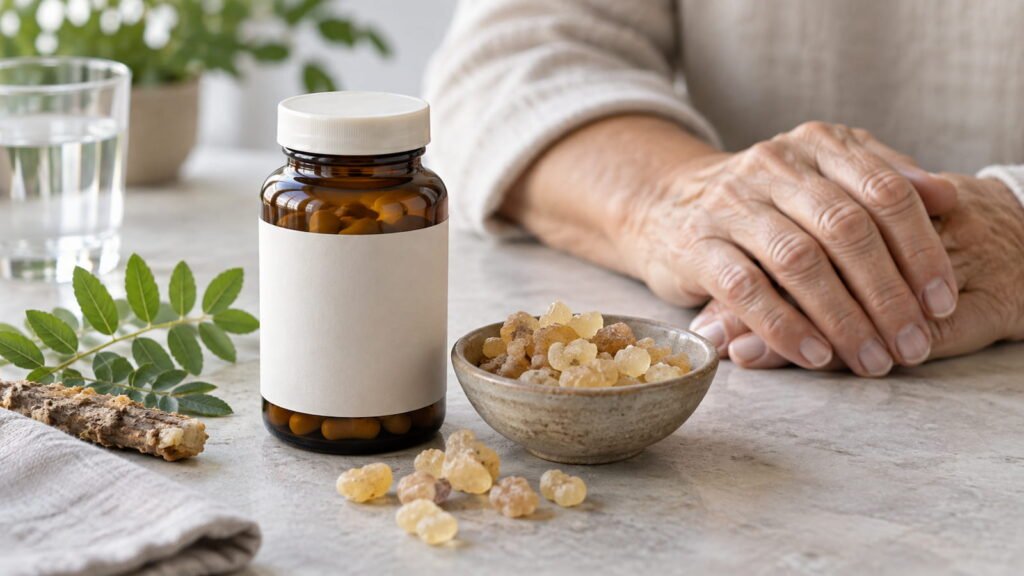
Boswellia for joint pain has become a common topic among people looking for supplement options for aching or stiff joints. Extracts from the Boswellia serrata tree appear in many joint-support formulas, often alongside ingredients such as turmeric, glucosamine, or collagen.
But popularity does not automatically mean that a supplement is proven to work.
Human studies suggest that certain Boswellia extracts may help reduce pain and improve physical function in some people with osteoarthritis, particularly knee osteoarthritis. At the same time, studies have used different extracts, doses, and formulations, and the overall evidence still has important limitations.
This guide explains what Boswellia is, what researchers have actually found, how it differs from other joint supplements, possible side effects, and what to look for before considering a product.
What Is Boswellia Serrata?
Boswellia serrata is a tree whose gum resin has been used traditionally in Ayurvedic medicine. The resin from Boswellia species is also associated with frankincense.
Modern dietary supplements usually contain concentrated extracts of the resin rather than simply using raw frankincense. These extracts may contain compounds called boswellic acids, which researchers have studied for potential anti-inflammatory effects.
This distinction matters because an oral standardized Boswellia extract used in a clinical study is not necessarily equivalent to frankincense essential oil, raw resin, or an unrelated supplement sold under a similar name.
The NCCIH Boswellia overview notes that oral Boswellia has been studied for several conditions and that some studies suggest benefits for osteoarthritis, but it also emphasizes that many studies have been small or limited in quality.
Why Is Boswellia Used for Joint Pain?
Joint pain can result from many different problems, including osteoarthritis, inflammatory arthritis, injury, overuse, gout, and other medical conditions. Boswellia does not address all of these causes in the same way.
Interest in Boswellia largely comes from research into its potential effects on inflammatory pathways.
Boswellic Acids and Inflammation
Boswellia extracts contain several boswellic acids. Laboratory research has examined how some of these compounds interact with biological pathways involved in inflammation.
One commonly discussed pathway involves an enzyme called 5-lipoxygenase, which contributes to the production of inflammatory molecules called leukotrienes. However, laboratory findings have not always translated neatly into effects inside the human body.
For example, experimental research has found that certain boswellic acids can influence 5-lipoxygenase under some laboratory conditions, while other experiments found that the same effects were much less clear in human whole blood. A plausible biological mechanism is not the same thing as proven clinical benefit.
That is why human randomized trials and systematic reviews matter more than simply saying that Boswellia is “anti-inflammatory.”
Does Boswellia for Joint Pain Actually Work?
The most useful human evidence currently relates to knee osteoarthritis.
Several randomized trials have reported improvements in pain, stiffness, or physical function after people with knee osteoarthritis took standardized Boswellia extracts.
However, the research should be interpreted carefully.
A 2024 systematic review and meta-analysis examined multiple Boswellia studies in knee osteoarthritis. When all of the studies were pooled, high differences between studies made the overall effect uncertain. In subgroup analysis comparing Boswellia with placebo, however, the researchers found evidence suggesting improvement in osteoarthritis symptoms. They concluded that better-quality trials are still needed.
A later systematic review and network meta-analysis that included 20 randomized trials also found potentially beneficial effects from certain Boswellia formulations, particularly for measures of knee pain, stiffness, and function. Rates of adverse events were not significantly different across the comparisons examined.
Individual trials have also produced positive results. For example, a 2024 randomized placebo-controlled study of a standardized proprietary Boswellia extract reported improvements in pain and physical function over 90 days. But that study tested a specific standardized formulation, and several study authors were affiliated with companies connected to that formulation.
That does not mean the results should be dismissed. It does mean they should not automatically be generalized to every Boswellia supplement available online or in stores.
The most reasonable conclusion is that Boswellia shows promise for knee osteoarthritis symptoms, but it is not established as a universal or guaranteed joint-pain treatment.
Boswellia for Osteoarthritis vs Other Types of Arthritis
The word “arthritis” covers many different conditions.
Osteoarthritis involves structural and biological changes within a joint and commonly causes pain, stiffness, and reduced mobility. Rheumatoid arthritis, in contrast, is an autoimmune inflammatory disease that requires a very different medical approach.
If you are unsure about the distinction, our guide to osteoarthritis and rheumatoid arthritis explains how the two conditions differ.
Most modern Boswellia research relevant to joint symptoms has focused on knee osteoarthritis. There is not equivalent high-quality evidence showing that taking Boswellia treats rheumatoid arthritis, psoriatic arthritis, gout, or every other source of joint pain.
This matters because using a supplement without knowing why a joint hurts could delay appropriate evaluation.
Persistent joint pain deserves medical attention when the cause is unclear. Swelling, redness, warmth around a joint, fever, or significant pain following an injury are additional reasons to seek medical assessment rather than relying on a supplement.
Boswellia vs Turmeric for Joint Pain
Boswellia and turmeric are frequently grouped together because both are botanical supplements studied for joint symptoms.
Turmeric contains compounds called curcuminoids, while Boswellia contains boswellic acids. They are therefore different supplements with different chemical constituents, even though some of the proposed effects overlap.
Research reviews have found potentially beneficial results for both turmeric/curcumin and Boswellia formulations in knee osteoarthritis. However, studies differ considerably in formulation, dose, duration, and quality, making it difficult to declare one ingredient universally superior. An earlier systematic review also noted that much of the Boswellia evidence came from relatively small trials.
For a closer look at curcumin research, see our guide to turmeric for joint pain.
There is also no need to assume that combining multiple ingredients automatically works better. A multi-ingredient supplement may make it harder to know which ingredient is helping, what dose is being provided, or which component is causing a side effect.
What to Look for in a Boswellia Supplement
If you are considering a Boswellia supplement, the label deserves more attention than marketing phrases on the front of the bottle.
1. Check the Actual Botanical Ingredient
Look for a label that clearly identifies Boswellia serrata rather than relying only on vague wording such as “joint herbal blend.”
The Supplement Facts panel should also make it possible to understand how much of the ingredient is present per serving.
2. Understand What “Standardized” Means
Some Boswellia products state that they are standardized to a certain concentration of boswellic acids or another marker compound.
Standardization can help manufacturers produce more consistent extracts, but the word “standardized” by itself does not prove that a supplement is effective or high quality.
The NIH Office of Dietary Supplements explains that standardization is not legally required for supplements in the United States and that the term alone does not guarantee quality.
3. Do Not Assume Every Extract Matches the Research
This is one of the most important buying considerations.
Clinical studies frequently test specific extracts with particular manufacturing methods and concentrations. If another product contains a different extract, a different amount, or an unspecified proprietary blend, the study results may not apply directly to that product.
Research on one Boswellia formulation therefore should not be treated as proof that all Boswellia supplements work equally well.
4. Look for Independent Quality Testing
Independent testing can provide additional assurance that a supplement was manufactured properly, contains the ingredients stated on its label, and does not contain unacceptable levels of certain contaminants.
However, a quality seal does not prove that the supplement will relieve joint pain or that it is appropriate for you.
The NIH Office of Dietary Supplements guidance specifically notes this distinction when discussing third-party quality testing.
5. Be Cautious With Proprietary Blends
Products containing many ingredients may look more impressive, but more ingredients are not automatically better.
A simpler label can make it easier to determine how much Boswellia is actually present and whether the product resembles formulations that have been studied.
If you are comparing broader ingredient options, our guide to joint support supplements explains what to consider before buying.
Boswellia is also included in some multi-ingredient joint formulas rather than being sold on its own. One example is Joint Genesis, which combines Boswellia with several other joint-support ingredients. If you are comparing a finished formula rather than a standalone Boswellia supplement, our Joint Genesis review examines its ingredients, research, safety considerations, and overall value in more detail.
How Much Boswellia Should You Take?
There is no single evidence-based Boswellia dose that is appropriate for every person or every product.
Clinical trials have used different extracts, concentrations, dosing schedules, and treatment periods. Two supplements that both list Boswellia may also contain very different concentrations of active compounds.
For that reason, simply copying the milligram amount from a clinical trial may be misleading.
NCCIH notes that Boswellia serrata extracts at certain doses have been used without major safety problems in clinical trials lasting several months, but this safety information should not be interpreted as a universal recommended dose.
Follow the product label and discuss supplement use with a healthcare professional if you take medication, have a medical condition, are preparing for surgery, or are unsure whether a supplement is appropriate for you.
How Long Does Boswellia Take to Work?
There is no guaranteed timeline.
Some clinical trials of specific Boswellia extracts have reported symptom changes relatively early, while others have assessed outcomes after several weeks or months. These findings cannot establish that every user or every product will work within the same period.
Be especially cautious with marketing claims promising dramatic improvement within a precise number of days.
A study result describes what happened in a study population—it does not guarantee the same response for an individual person.
If joint symptoms continue or worsen, do not keep delaying medical evaluation simply because you are waiting for a supplement to work.
Boswellia Side Effects and Safety
Boswellia appears to be reasonably well tolerated in available short- and medium-term clinical research, but “natural” does not mean risk-free.
NCCIH reports that oral Boswellia has been used with apparent safety in several clinical trials, while also emphasizing that long-term and high-quality evidence remains limited.
Some studies have reported minor gastrointestinal problems, and allergic reactions are also possible.
Medication Interactions
People taking prescription or over-the-counter medicines should discuss Boswellia with a healthcare professional before starting it.
Memorial Sloan Kettering Cancer Center specifically advises caution for people taking blood-thinning medicines such as warfarin because Boswellia may potentially increase bleeding risk. Laboratory research has also raised the possibility of other drug interactions, although the clinical significance of some of these findings remains uncertain.
Do not stop, reduce, or replace prescribed arthritis medication because you start using Boswellia.
Pregnancy and Breastfeeding
NCCIH states that little is known about the safety of Boswellia in medicinal amounts during pregnancy or breastfeeding.
Because the evidence is limited, anyone who is pregnant, planning pregnancy, or breastfeeding should speak with a qualified healthcare professional before using a concentrated Boswellia supplement.
Who Should Be Especially Careful With Boswellia?
Extra caution is sensible if you:
- take prescription medicines, particularly anticoagulant or antiplatelet medicines;
- are pregnant or breastfeeding;
- are preparing for a medical or surgical procedure;
- have unexplained or rapidly worsening joint symptoms;
- have a history of reactions to herbal supplements;
- are already taking several joint-health supplements containing overlapping ingredients.
A pharmacist can also be a useful resource for checking possible supplement–medication interactions.
Are Boswellia Supplements FDA Approved?
No. In the United States, dietary supplements are regulated differently from prescription and over-the-counter drugs.
The FDA guidance for consumers using dietary supplements explains that the agency generally does not approve dietary supplements for safety and effectiveness before they are marketed. Manufacturers and distributors are responsible for meeting applicable safety and labeling requirements, while FDA can take enforcement action when problems arise.
This is another reason not to assume that a supplement’s presence on a store shelf proves that its advertised health benefits have been independently verified.
Is Boswellia Worth Considering for Joint Pain?
For someone with diagnosed knee osteoarthritis who is interested in complementary approaches, Boswellia may be reasonable to discuss with a healthcare professional.
There is enough research to consider the ingredient scientifically interesting, and several studies suggest possible improvements in pain or function.
But there are equally important reasons to remain cautious:
- many trials are relatively small;
- products and extracts differ considerably;
- some positive research involves proprietary formulations;
- research is concentrated mainly in knee osteoarthritis;
- longer-term evidence remains limited;
- evidence from one standardized extract cannot automatically be applied to another supplement.
Boswellia should therefore be viewed as a possible complementary option rather than a proven replacement for established arthritis care.
Other supplements have similarly mixed evidence. For example, you can also review the research on collagen for joint pain before deciding whether any joint supplement fits your needs.
Conclusion
Boswellia for joint pain has more scientific support than many purely marketing-driven herbal claims, particularly for symptoms related to knee osteoarthritis. Some clinical trials and research reviews suggest that standardized Boswellia extracts may improve pain, stiffness, or physical function.
However, the evidence is still not strong enough to guarantee benefits, and studies of one particular extract should not be treated as proof for every Boswellia supplement.
If you choose to explore Boswellia, focus on a clear ingredient label, realistic claims, appropriate quality testing, and possible medication interactions. Most importantly, use supplements as part of an informed approach to joint health—not as a substitute for identifying and treating the underlying cause of persistent joint pain.
Frequently Asked Questions
Does Boswellia help arthritis?
Research suggests that some standardized Boswellia extracts may help reduce symptoms in people with knee osteoarthritis, particularly pain, stiffness, and reduced function. However, evidence is not strong enough to conclude that Boswellia treats every type of arthritis or works for everyone.
Is Boswellia the same as frankincense?
They are closely related but the terms should not be treated as interchangeable in supplement research. Frankincense comes from Boswellia resin, while clinical trials generally use specific oral Boswellia extracts. Evidence involving a standardized oral extract does not automatically apply to frankincense essential oil or other preparations.
Can you take Boswellia and turmeric together?
Products containing both ingredients are available, but combining supplements does not automatically make them more effective. It can also complicate dosing and medication-interaction considerations. Talk with a healthcare professional or pharmacist before combining herbal supplements, particularly if you take medication.
Is Boswellia safe to take every day?
Boswellia has been used daily in clinical trials for several months with generally acceptable safety, but long-term evidence is more limited. Appropriate use depends on the specific extract, other medications, medical history, and individual circumstances. A healthcare professional can help determine whether regular use is appropriate for you.