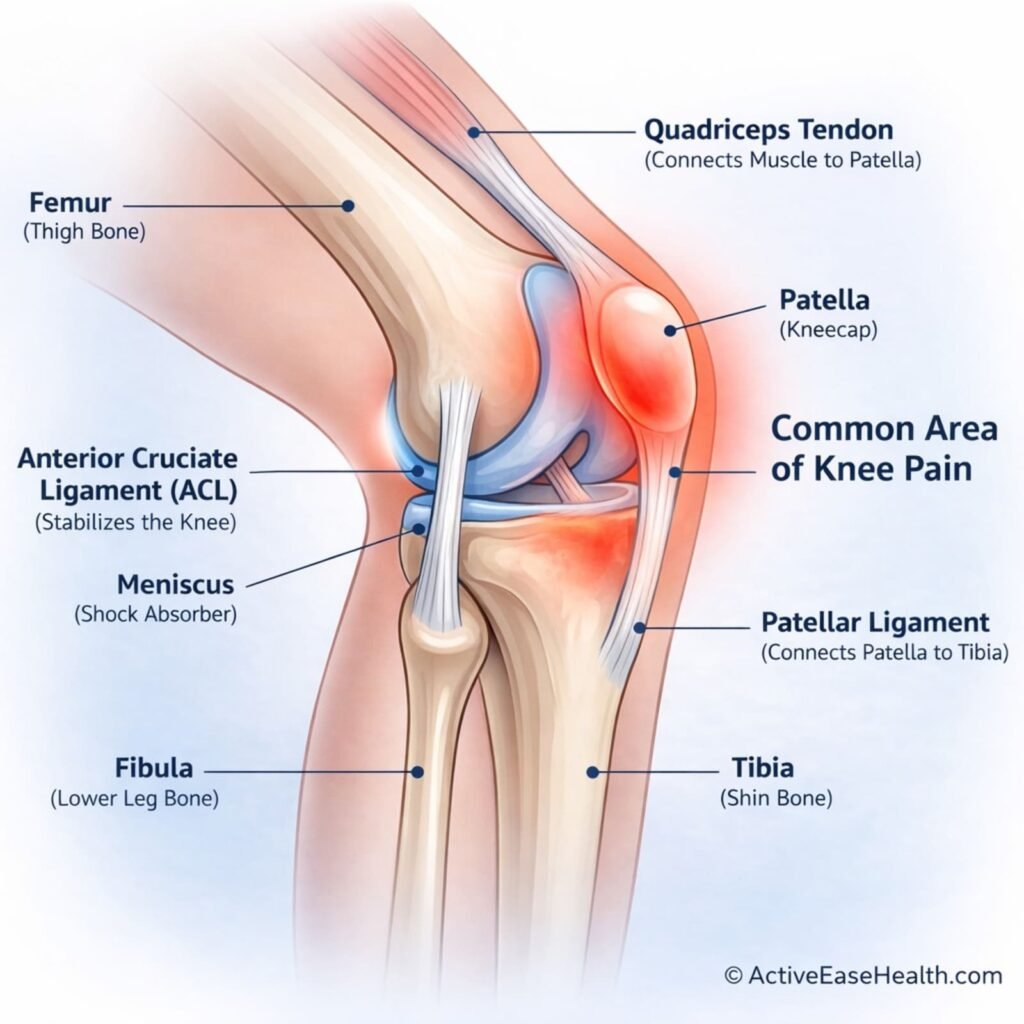
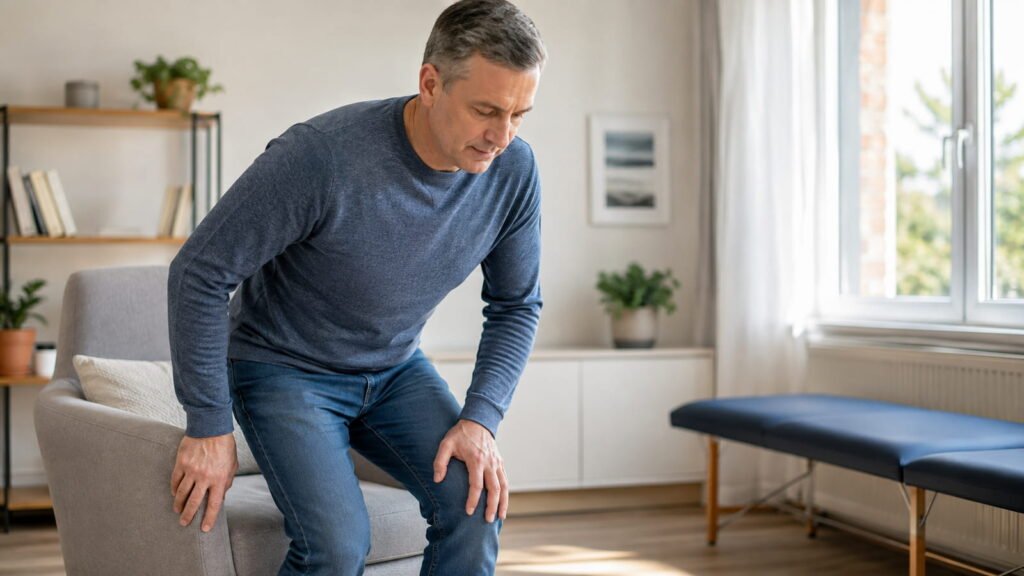
Knee stiffness after sitting can make the first few steps after getting out of a chair feel awkward, tight, or uncomfortable. Your knee may feel slow to straighten, slightly restricted, or as though it needs a few movements before it starts moving more normally.
Sometimes this happens simply after keeping the knee bent and inactive for a long period. In other cases, repeated stiffness may be associated with osteoarthritis, irritation around the kneecap, swelling, a previous knee injury, or another joint condition. Knee osteoarthritis, for example, can cause stiffness and swelling that are more noticeable after sitting or resting.
The pattern matters. Brief stiffness that improves with gentle movement is different from a knee that stays swollen, locks, gives way, becomes increasingly painful, or cannot move normally. This guide explains common possibilities, practical ways to get moving again, and signs that should be checked by a healthcare professional.
Why Does Your Knee Feel Stiff After Sitting?
Sitting keeps the knee in a relatively fixed, bent position. When you stand again, the joint, muscles, tendons, and other surrounding tissues have to transition quickly back into movement and weight-bearing.
Some people notice only a temporary sense of tightness. Others have pain, swelling, reduced range of motion, clicking, or weakness along with the stiffness. These additional symptoms can provide useful clues, although they are not enough to diagnose the cause on their own.
If your main problem occurs while you are already walking rather than immediately after inactivity, our guide to knee joint pain when walking covers that different symptom pattern in more detail.
When Knee Stiffness After Sitting May Be Temporary
Staying in One Position for Too Long
Long periods at a desk, in a car, on a plane, or on the sofa can make a knee feel less comfortable when movement restarts. This does not necessarily mean there is serious joint damage.
If stiffness is mild, occurs mainly after prolonged inactivity, and eases quickly once you move, the pattern may simply reflect how your knee responds to being held in one position.
Stiffness When Movement Restarts
The first few movements after sitting can feel different from movement once you are already active. For some people, gently bending and straightening the knee before standing makes the transition feel easier.
However, stiffness that repeatedly lasts a long time, becomes progressively worse, or interferes with normal walking deserves more attention.
Common Causes of Knee Stiffness After Sitting
Knee Osteoarthritis
Osteoarthritis is an important possible cause of repeated knee stiffness, particularly in middle-aged and older adults. It develops as tissues within the joint change over time and may cause pain, swelling, stiffness, reduced movement, or grinding sensations.
AAOS notes that knee arthritis symptoms may be worse in the morning or after sitting or resting, and the joint may become difficult to bend or straighten.
That does not mean every stiff knee is osteoarthritis. Age, injury history, symptom duration, swelling, activity pattern, examination findings, and sometimes imaging all help healthcare professionals evaluate the cause.
Patellofemoral Pain
Patellofemoral pain affects the area around or behind the kneecap. It is often associated with activities that load the knee while it is bent, such as stairs, squatting, running, or prolonged sitting.
AAOS lists pain at the front of the knee after sitting for a long time with the knees bent as a common symptom pattern.
Some people describe this as pain rather than true stiffness, while others notice both tightness and discomfort when first standing. Symptoms around the kneecap should therefore be considered separately from deep joint stiffness.
Swelling or Inflammation Around the Knee
Swelling can physically limit how freely a knee bends and straightens. It may develop after irritation, overuse, arthritis, injury, bursitis, or other inflammatory problems.
MedlinePlus notes that joint swelling can cause pain or stiffness, while arthritis and joint infection can also produce swelling, redness, or warmth.
A visibly swollen knee should not automatically be treated as ordinary “sitting stiffness,” particularly when the swelling is new, significant, or accompanied by warmth or increasing pain.
Previous Knee Injury or Meniscus Problems
Previous injuries involving the meniscus, ligaments, cartilage, or other knee structures can sometimes leave a joint prone to stiffness or restricted movement.
A meniscus tear may cause stiffness or swelling, difficulty bending or straightening the knee, catching, or a feeling that the knee gives way.
New symptoms following a twist, fall, sports injury, or other trauma should be evaluated differently from gradual stiffness that develops without a clear injury.
Bursitis and Other Soft-Tissue Irritation
The knee contains small fluid-filled bursae that help reduce friction around moving tissues. Irritation of one of these structures can cause localized pain, tenderness, or stiffness.
For example, AAOS notes that pes anserine bursitis can cause stiffness or pain after sitting with the knee bent for a long time, usually along the inner side of the knee below the joint line.
The exact location of the discomfort can therefore matter when a healthcare professional evaluates persistent symptoms.
Inflammatory Arthritis
Inflammatory forms of arthritis can also cause stiffness, but the pattern is often broader than one knee becoming briefly stiff after sitting.
Symptoms may involve several joints, prolonged morning stiffness, swelling, warmth, fatigue, or periods when inflammation becomes more active. If you are trying to understand the difference between common wear-related arthritis and inflammatory disease, our guide to osteoarthritis vs rheumatoid arthritis explains the major patterns.
A single symptom such as stiffness after sitting cannot distinguish the two conditions.
Stiffness After Knee Surgery or Significant Injury
Reduced movement can occur during recovery from surgery or a major injury. Scar tissue, swelling, pain, muscle weakness, and the recovery process itself can affect range of motion.
If you are recovering from a procedure or known injury, follow the rehabilitation plan provided by your surgeon or physical therapist rather than applying generic exercise advice from an article.
What Your Other Symptoms May Tell You
Stiffness With Pain
Mild aching that eases as the knee loosens is different from severe, sharp, or rapidly worsening pain.
Pay attention to where the pain occurs: around the kneecap, inside or outside the joint, behind the knee, or along a tendon. Location does not provide a diagnosis by itself, but it can help guide an examination.
Stiffness With Swelling
Swelling suggests that more is happening than simple temporary tightness. Notice whether the knee looks visibly larger, feels warm, or becomes more swollen after activity.
Sudden or marked swelling, especially after an injury, deserves greater caution.
Locking, Catching, or Giving Way
A knee that occasionally clicks without pain is not the same as a knee that becomes mechanically stuck.
Locking, repeated giving way, inability to fully move the knee, or painful clicking should not be dismissed as normal stiffness. NHS guidance advises urgent assessment when the knee locks, gives way, is very painful, becomes badly swollen, or cannot bear weight.
Stiffness in Both Knees or Other Joints
If stiffness affects both knees or several joints — particularly with swelling or prolonged morning symptoms — the overall pattern becomes more important than the fact that stiffness appears after sitting.
Our separate guide to morning joint stiffness explains how timing and duration after waking may help distinguish different patterns without attempting to self-diagnose.
How to Relieve Knee Stiffness After Sitting
Move the Knee Gently Before You Stand
If the knee is mildly stiff and there has been no major injury, try a few comfortable movements before placing your full weight on it.
While seated, you might slowly straighten the leg and then allow it to bend again several times within a comfortable range. The goal is simply to reintroduce movement — not to force the knee through pain.
Stop if movement causes sharp pain, increasing swelling, instability, or a sensation that the knee is stuck.
Break Up Long Periods of Sitting
If long periods of inactivity consistently trigger stiffness, changing position periodically may be more useful than waiting until the knee becomes very tight.
Short movement breaks can include standing, walking briefly, or gently moving the knees and ankles. You do not need an intense exercise session every time you leave your chair.
For broader everyday movement habits, see our guide on how to improve joint mobility naturally.
Build Strength and Mobility Gradually
Strong muscles around the knee can help support movement and everyday function. A balanced program may involve the quadriceps, hamstrings, hips, calves, and other supporting muscles.
AAOS includes stretching and strengthening movements in its knee conditioning program and advises performing exercises gradually without ignoring pain.
If you are new to exercise or have sensitive joints, our guide to the best exercises for joint pain relief and mobility provides a broader introduction to gradual, low-impact movement.
Consider Heat or Ice Based on Your Symptoms
Heat and cold have different practical roles.
Gentle warmth may feel more comfortable when the main problem is stiffness or tightness without obvious swelling. Cold may be more useful after recent irritation when the knee feels swollen or warm.
Neither option treats the underlying cause. Our dedicated guide to heat or ice for joint pain explains when each may be more appropriate and how to protect the skin.
What Not to Do With a Stiff Knee
Avoid treating every stiff knee as though it needs aggressive stretching or exercise.
- Do not force the knee deeply into flexion or extension when movement is painful.
- Do not repeatedly “test” a painful knee by squatting or twisting it.
- Do not push through locking, instability, or sharp pain.
- Do not remain completely inactive for long periods unless a healthcare professional has advised rest.
- Do not assume stiffness is harmless if it is accompanied by major swelling, redness, fever, or an inability to bear weight.
- Do not begin intense strengthening immediately after a significant injury without appropriate guidance.
When to See a Healthcare Professional
Arrange a medical assessment if knee stiffness keeps returning, lasts longer over time, interferes with walking or daily activities, or occurs with persistent pain or swelling.
Seek more urgent medical help when the knee is very painful, badly swollen, visibly deformed, unable to bear weight, locked, repeatedly giving way, or hot and red while you also have fever or feel unwell. NHS guidance specifically highlights these patterns as reasons for urgent assessment.
After a significant injury, severe pain, inability to move the knee, limping, or marked swelling also warrants prompt evaluation.
A healthcare professional may ask about when the stiffness begins, how long it lasts, whether it improves with movement, where pain occurs, whether the knee swells or locks, and whether there has been an injury. Examination or imaging may be recommended depending on the suspected cause.
Can You Prevent Knee Stiffness After Sitting?
Not every cause of stiffness can be prevented, but several habits may reduce avoidable stiffness related to prolonged inactivity.
- Change position periodically during long periods of sitting.
- Straighten and bend the knee gently before standing when it feels tight.
- Build leg strength gradually rather than making sudden jumps in activity.
- Avoid repeatedly sitting in positions that clearly aggravate your symptoms.
- Maintain regular, comfortable physical activity when medically appropriate.
- Address recurring knee pain or swelling rather than simply working around it.
Prevention should be matched to the cause. A person with mild inactivity-related stiffness will need a different approach from someone recovering from a meniscus injury, managing osteoarthritis, or experiencing inflammatory joint disease.
Conclusion
Knee stiffness after sitting is common, but the reason can vary. Temporary stiffness may simply occur after the knee has remained bent and inactive, while repeated symptoms can also be associated with osteoarthritis, patellofemoral pain, swelling, bursitis, previous injury, or other joint conditions.
Gentle movement before standing, regular movement breaks, and gradual strengthening may help when symptoms are mild and uncomplicated. But stiffness should not be pushed through when the knee is severely painful, swollen, unstable, locked, or difficult to bear weight on.
Pay attention to the whole symptom pattern, not just the stiffness itself. Persistent or worsening symptoms deserve professional evaluation so the cause — rather than only the sensation of stiffness — can be addressed.
Frequently Asked Questions
Is knee stiffness after sitting a sign of arthritis?
It can be, but not always. Knee osteoarthritis can cause pain and stiffness that are worse after sitting or resting, but prolonged positioning, kneecap irritation, swelling, bursitis, previous injuries, and other problems can produce similar symptoms.
Why does my knee loosen after I start walking?
Some people experience temporary stiffness after inactivity that becomes less noticeable once comfortable movement resumes. However, improvement with movement does not identify the exact cause. Repeated or worsening stiffness should still be evaluated in the context of your other symptoms.
Should I use heat or ice for a stiff knee?
Heat may feel more useful when stiffness and tightness are the main symptoms without obvious swelling. Cold may be preferable when the knee is recently irritated, warm, or swollen. Protect your skin and avoid using either method as a substitute for evaluation of severe or persistent symptoms. NHS guidance also supports ice for knee pain and swelling in appropriate situations.
Can sitting too long make knee stiffness worse?
Yes. Some knee conditions, including osteoarthritis and patellofemoral problems, can become more noticeable after prolonged sitting or resting.
When should I worry about a stiff knee?
Seek medical advice when stiffness is persistent, worsening, or affecting daily function. More urgent assessment is appropriate for severe pain, major swelling, inability to move or bear weight, locking, repeated giving way, deformity, or a hot red knee accompanied by fever or feeling unwell.