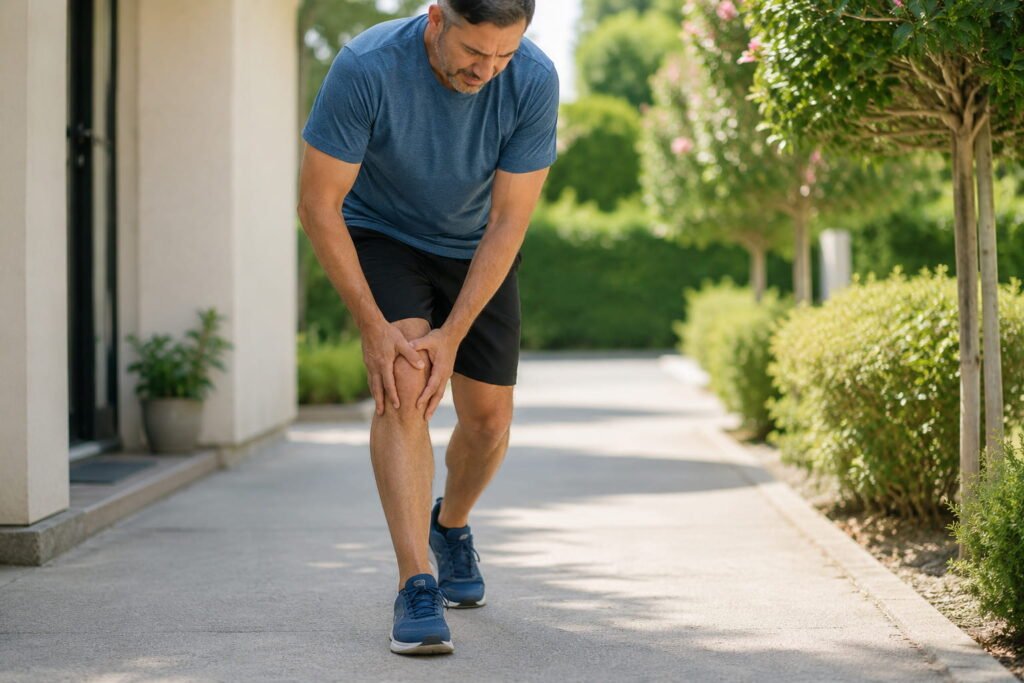
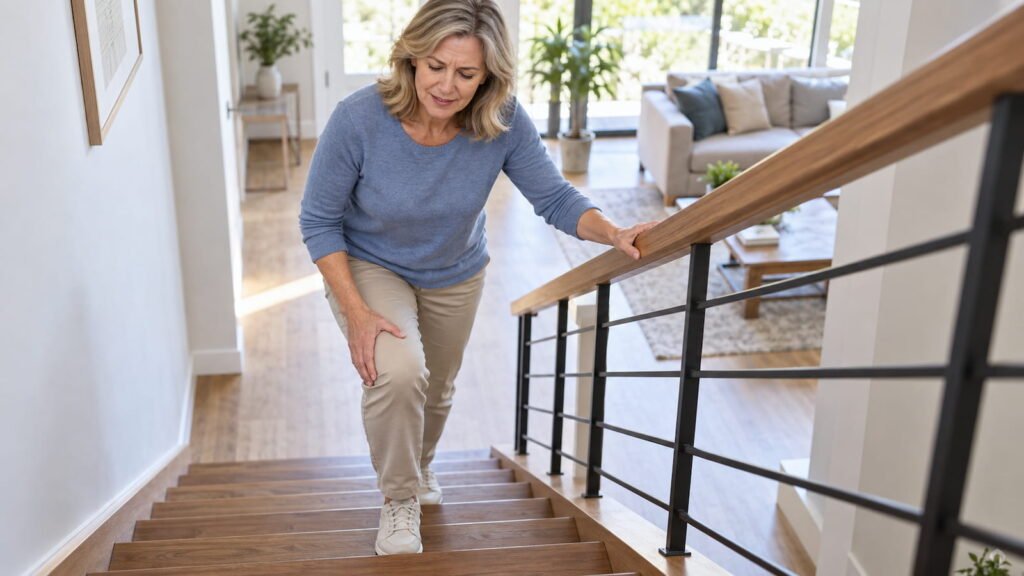
Knee pain when climbing stairs can be frustrating because the same knee may feel relatively comfortable while standing or walking on level ground. You may notice an ache around the kneecap, discomfort deeper inside the joint, pain below the kneecap, or symptoms that are worse going down than going up.
Stairs place different demands on the knee than ordinary walking. The knee bends more, the thigh muscles work harder to control your body, and structures around the kneecap and joint have to tolerate greater loading through a wider range of motion.
That does not mean stair pain automatically points to arthritis or damaged cartilage. Patellofemoral pain, tendon irritation, osteoarthritis, changes in activity level, and previous injuries are among several possibilities.
The pattern of your symptoms matters. Where the pain occurs, whether there is swelling, whether the knee locks or gives way, and whether symptoms began after an injury can all provide useful clues.
This guide explains why stairs may trigger knee pain, common causes, what may help, and when you should seek medical advice.
Why Does Your Knee Hurt More on Stairs?
Climbing and descending stairs requires more knee bending and muscle control than walking across a flat surface.
As you step upward, the quadriceps muscles at the front of your thigh help straighten the knee and lift your body. When you come down, those muscles also work to control your descent rather than letting your body simply drop onto the next step.
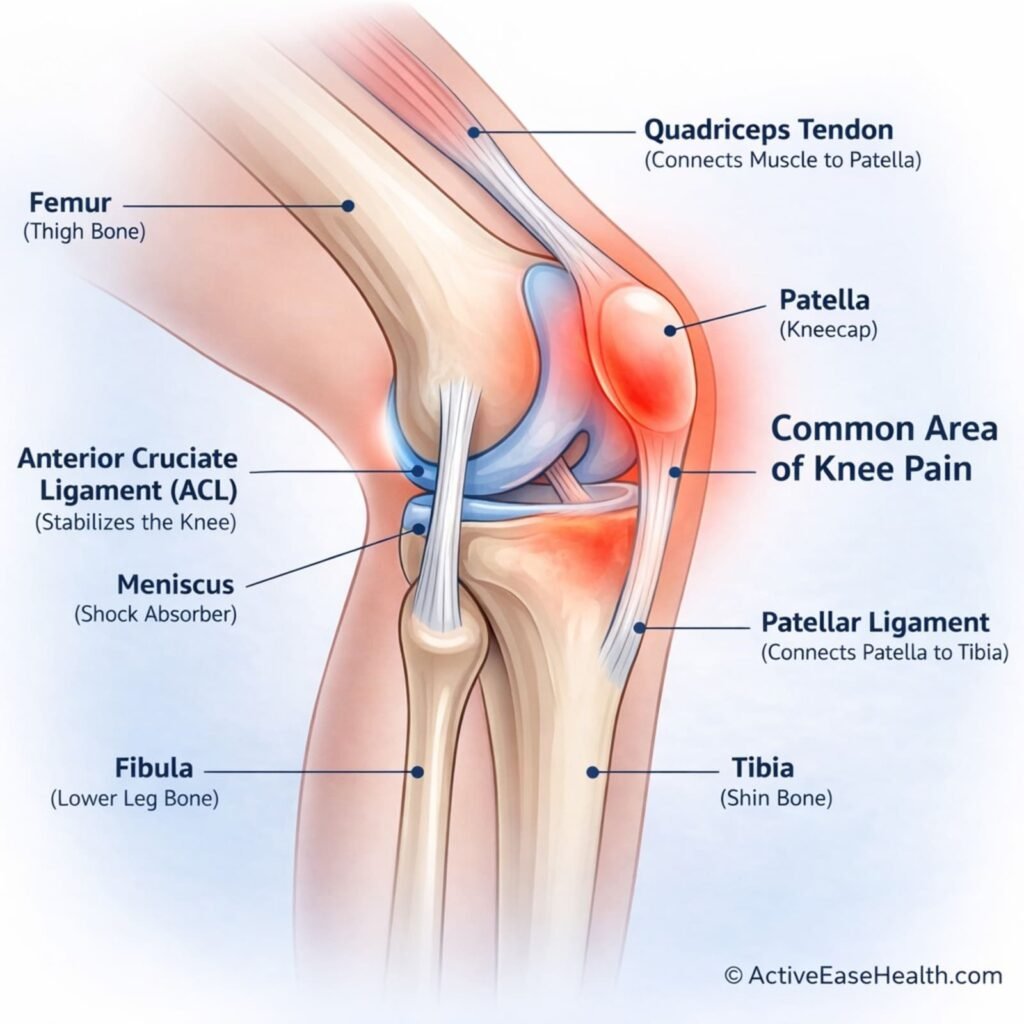
At the same time, the kneecap moves within a groove at the end of the thigh bone as the knee bends and straightens. If tissues around this area are irritated or your knee is not currently tolerating that amount of activity well, stairs may expose symptoms that are much less noticeable on level ground.
This is one reason patellofemoral pain syndrome often becomes noticeable during stair climbing, squatting, running, or after sitting with the knee bent for a long time.
If your main symptom instead occurs during ordinary level walking, our guide to knee joint pain when walking covers that broader pattern separately.
Common Causes of Knee Pain When Climbing Stairs
Several conditions and temporary problems can cause knee pain on stairs. The following possibilities can overlap, and symptoms alone cannot confirm a diagnosis.
Patellofemoral Pain
Patellofemoral pain is one of the most common explanations for discomfort around or behind the kneecap during stairs.
The pain is often felt at the front of the knee or around the edges of the kneecap. Some people describe a dull ache, while others notice sharper discomfort during certain movements.
Activities that repeatedly bend the knee under load — including climbing or descending stairs, squatting, running, and getting up after prolonged sitting — can aggravate this pattern.
A recent increase in training, reduced strength or conditioning, changes in movement patterns, and other individual factors may contribute.
Some people also notice clicking or grinding. These sounds do not automatically mean that the knee is being damaged, especially when they are painless. Painful clicking, locking, major swelling, or instability deserves more attention.
Patellofemoral symptoms can also overlap with knee stiffness after sitting, especially when keeping the knee bent for a long period makes the front of the knee uncomfortable.
Knee Osteoarthritis
Osteoarthritis can also make stairs uncomfortable.
Knee osteoarthritis may cause activity-related pain, stiffness after rest, reduced movement, swelling, or a grinding sensation. Symptoms can vary considerably between people and may fluctuate from day to day.
Stair climbing may become difficult because bending and loading the knee can aggravate a sensitive joint.
However, pain on stairs by itself does not prove that you have osteoarthritis. Age, symptom history, morning stiffness, swelling, function, previous injuries, and a clinical examination all matter.
Imaging is also not automatically necessary for every person with suspected osteoarthritis. Current clinical guidance emphasizes the overall symptom pattern and physical function rather than treating an X-ray alone.
If osteoarthritis is confirmed, appropriate exercise and symptom management are generally more important than avoiding all movement.
Patellar Tendon Irritation
The patellar tendon connects the kneecap to the upper part of the shin bone and helps transfer force when the knee straightens.
When this tendon becomes overloaded or irritated, pain is often felt just below the kneecap.
Activities involving repeated quadriceps effort can make symptoms more noticeable, including:
- climbing stairs;
- running;
- jumping;
- squatting;
- rapidly increasing exercise volume or intensity.
Patellar tendon problems are particularly associated with repeated loading, although you do not have to be a competitive athlete to develop symptoms.
Temporarily reducing the activity that clearly aggravates the tendon may be useful, but this does not normally mean avoiding all movement indefinitely.
Meniscus or Other Knee Injury
If knee pain began after twisting, pivoting, falling, or another significant injury, a meniscus, ligament, or other structure may be involved.
A meniscus problem may cause pain along the joint line and sometimes swelling, catching, or difficulty fully moving the knee.
Mechanical symptoms deserve particular attention. A knee that becomes genuinely locked and cannot fully straighten is different from harmless clicking or occasional stiffness.
Stairs may aggravate an injured knee because they require repeated bending and controlled weight-bearing.
If you recently injured the knee and now have substantial swelling, instability, difficulty bearing weight, or restricted movement, do not rely on self-treatment alone.
A Sudden Increase in Activity
Not every episode of stair-related knee pain means there is a specific joint disease.
Sometimes the knee simply has not adapted to a sudden increase in demand.
Examples include starting a new workout routine, adding hill or stair training, returning to running after a long break, substantially increasing walking, or repeatedly using stairs more often than usual.
Your tissues need time to adapt to changing workloads.
This does not mean exercise is harmful. Rather, large jumps in activity can temporarily exceed what the knee is prepared to tolerate.
Reducing the aggravating activity for a short period and then building back gradually may be more useful than either pushing through worsening pain or stopping all activity for weeks.
Knee Pain Going Upstairs vs Going Downstairs
Some people experience pain primarily when going upstairs, while others find coming down much worse.
The difference can be useful information, but it does not diagnose the cause.
Going upstairs requires the leg muscles to produce force to lift your body onto the next step. Coming downstairs requires those muscles to control your body as you lower yourself onto the leg below.
Both directions involve knee bending and substantial muscle control.
Patellofemoral pain can occur with either direction, and osteoarthritis may also make both climbing and descending stairs uncomfortable.
Pain that is especially noticeable while descending can sometimes reflect difficulty tolerating the controlled loading required as the knee bends.
Instead of trying to diagnose yourself from whether “up” or “down” hurts more, pay attention to the complete pattern:
- Where exactly is the pain?
- Is the knee swollen?
- Does it lock or give way?
- Is there pain during ordinary walking?
- Did symptoms begin after an injury?
- Does prolonged sitting also trigger discomfort?
- Is the pain becoming progressively worse?
Those details are more useful than one stair-related symptom in isolation.
Does the Location of Knee Pain Give Any Clues?
Pain location can help organize the possibilities, but it should never be used as a self-diagnosis.
Pain Around or Behind the Kneecap
Pain around, under, or behind the kneecap is commonly associated with patellofemoral pain.
This pattern may also become noticeable during squatting, running, kneeling, or prolonged sitting.
Some people experience creaking or clicking along with the discomfort.
Pain Just Below the Kneecap
More localized pain immediately below the kneecap may point toward the patellar tendon, particularly when jumping, running, squatting, or repeated stair use also causes symptoms.
Tenderness in that specific area may provide another clue, but professional assessment is needed to identify the cause accurately.
Pain on the Inside or Outside of the Knee
Pain along either side of the knee can have several possible explanations, including joint irritation, osteoarthritis affecting a particular compartment, soft-tissue problems, or previous injuries.
If side-of-knee pain began after a twist or is accompanied by swelling, catching, or locking, an injury should be considered rather than assuming the problem is simple overuse.
Pain Behind the Knee
Pain behind the knee has a different range of possible causes and should not automatically be attributed to the kneecap.
Persistent posterior knee pain, substantial swelling, or symptoms extending into the calf deserve medical assessment, particularly when symptoms appear suddenly or are accompanied by other concerning signs.
What Can Help Mild Knee Pain on Stairs?
The right approach depends on the cause. A recent injury, persistent swollen knee, or unstable knee needs a different plan from mild discomfort that followed a sudden increase in activity.
For uncomplicated symptoms, several conservative strategies may be reasonable.
Temporarily Reduce the Most Irritating Activity
If repeated stair climbing clearly worsens symptoms, temporarily reducing unnecessary trips up and down stairs can give the knee a chance to settle.
This is activity modification, not permanent avoidance.
When symptoms improve, gradual exposure to normal activity is generally more useful than becoming increasingly inactive out of fear of pain.
Build Strength Gradually
The quadriceps, hips, hamstrings, calves, and other supporting muscles contribute to controlled knee movement.
A properly selected strengthening program can improve function and help the knee tolerate everyday activities.
For people with osteoarthritis, therapeutic exercise is considered a core treatment. Exercise should be matched to the individual rather than based on a one-size-fits-all routine.
If you are new to movement-based joint care, our guide to exercises for joint pain relief and mobility provides a broader introduction to gradual, low-impact exercise.
A physical therapist can be particularly helpful when you are unsure which movements are appropriate, symptoms keep recurring, or exercise consistently aggravates the knee.
Use Heat or Cold Based on the Situation
Heat and cold may provide temporary symptom relief, but they do not treat the underlying cause.
Cold may feel more useful after activity when the knee feels irritated or swollen. Gentle warmth may feel more comfortable when stiffness is the main problem and there is no obvious acute swelling.
Our guide to heat or ice for joint pain explains when each option may be more appropriate and how to protect your skin.
If you have reduced sensation, circulation problems, or another condition that affects your ability to detect heat or cold, ask a healthcare professional before using temperature therapy regularly.
Check Your Activity Progression
Think about what changed shortly before the pain appeared.
Did you suddenly start using a stair machine? Increase running mileage? Add hills? Return to exercise after several inactive months? Move into a building that requires frequent stair use?
If the answer is yes, the issue may partly involve how quickly the workload increased.
Reducing the aggravating load temporarily and rebuilding gradually can be more sustainable than repeatedly cycling between pushing too hard and complete rest.
Wear Appropriate Footwear
Shoes cannot correct every cause of knee pain, but comfortable, secure footwear can support stable movement during daily activity.
Replace footwear that is badly worn or clearly unsuitable for what you are doing.
If arthritis is part of the picture, our guide to walking shoes for arthritis explains useful footwear characteristics without claiming that one shoe design works for everyone.
Should You Wear a Knee Brace for Stair Pain?
A knee brace is not automatically necessary just because stairs hurt.
The usefulness of a brace depends on the underlying problem. Some people with specific instability, alignment issues, injuries, or professionally identified biomechanical needs may benefit from support, but routine bracing is not appropriate for every painful knee.
For knee osteoarthritis specifically, current NICE guidance does not recommend routinely offering braces or supports unless particular circumstances justify them and the device is likely to improve movement and function.
If you are considering one, our guide to choosing a knee brace for knee pain explains the main brace types, limitations, and fitting considerations.
A brace should support an appropriate management plan — not substitute for understanding why the knee hurts.
Practical Ways to Make Stairs More Comfortable
While you work on the underlying problem, small changes may make stairs easier.
- Use the handrail for balance and to reduce the chance of losing control if the knee suddenly feels painful.
- Take stairs at a controlled pace instead of rushing.
- Avoid carrying unnecessarily heavy or bulky loads when your knee is already painful.
- Reduce repeated stair trips temporarily during a symptom flare when practical.
- Wear secure footwear rather than loose slippers or unstable shoes.
- Avoid suddenly adding stair workouts when your knee is not accustomed to them.
- If a healthcare professional has taught you a specific stair technique after an injury, surgery, or during severe symptoms, follow that individualized advice.
These adjustments are intended to make movement more manageable. They are not a replacement for medical evaluation when symptoms are persistent, worsening, or accompanied by warning signs.
When Knee Pain on Stairs Needs Medical Attention
Mild knee discomfort after an unusual increase in activity may settle with sensible load modification and gradual return to normal movement.
However, arrange a healthcare assessment if the pain keeps returning, lasts for several weeks, increasingly limits stairs or walking, or you cannot identify why it is happening.
Seek more urgent medical advice if:
- the knee is extremely painful;
- you cannot put weight on the leg;
- you cannot move or fully straighten the knee;
- the knee is badly swollen or visibly deformed;
- it repeatedly gives way;
- it becomes genuinely locked;
- substantial swelling develops after an injury;
- the knee is hot or red and you also have fever or feel unwell.
These symptoms can require more prompt assessment than ordinary activity-related discomfort.
The NHS knee pain guidance provides additional information on symptoms that warrant urgent or routine medical evaluation.
Conclusion
Knee pain when climbing stairs can have several explanations. Patellofemoral pain is a common possibility, particularly when discomfort is centered around the kneecap and also appears during squatting, running, or prolonged sitting. Knee osteoarthritis, patellar tendon irritation, previous injuries, and sudden increases in activity can also make stairs uncomfortable.
The direction of the stairs and location of the pain may provide clues, but neither can diagnose the problem by itself.
For mild symptoms without a significant injury or warning signs, sensible activity modification, gradual strengthening, appropriate footwear, and temporary symptom-relief measures may help.
Most importantly, avoid assuming that every painful knee needs complete rest, a brace, or a scan.
If your symptoms are persistent, worsening, swollen, unstable, mechanically locked, or significantly limiting normal activity, seek professional assessment so the underlying problem can be addressed rather than simply working around the stairs.
Frequently Asked Questions
Why does my knee hurt going upstairs but not when walking?
Stairs require more knee bending and muscular effort than level walking, so a problem that is relatively quiet on flat ground may become noticeable when you climb. Patellofemoral pain, tendon irritation, osteoarthritis, and reduced tolerance to increased activity are among the possibilities. The symptom by itself does not identify the cause.
Why is my knee pain worse going downstairs?
Descending stairs requires the thigh muscles to control your body as the knee bends and you lower yourself to the next step. This can aggravate a sensitive kneecap area, arthritic joint, tendon, or injured knee. Pain specifically on descent can be useful information for a clinician, but it is not diagnostic by itself.
Can arthritis cause knee pain when climbing stairs?
Yes. Knee osteoarthritis can cause activity-related pain and may make going up or down stairs uncomfortable. However, stair pain is also common with several non-arthritic knee problems, so you should not assume arthritis is the cause based only on this symptom.
Should I wear a knee brace when using stairs?
Not automatically. A brace may help certain people with specific instability, injuries, alignment issues, or other professionally identified needs, but it is not necessary for every type of knee pain. If you are considering a brace because stair pain keeps returning, identifying the cause and choosing the correct type is more important than simply buying a generic support.